The best spotting scopes for long range shooting in 2026
Our verdict for 2026: the Sightmark Latitude 20-60x80 XD Tactical (around $840) is the best long range spotting scope for most shooters, because it is the cheapest way to get a first focal plane mil-hash reticle in the box and an 80mm objective to use it with. Carrying it any distance? The Athlon Ares Gen II 15-45x65 (around $720) is 18 oz lighter with a deeper owner record, but its reticle is a separate purchase. The Athlon Cronus G2 UHD 7-42x60 (around $1,100) is the premium step-up.
Prices verified September 30, 2026; confirm the current price on the retailer page. Read what you can actually see at 1000 yards before you buy any of them.
A long range spotting scope has one job that an ordinary spotter does not: letting you measure a miss and call a correction the shooter can dial. That takes a ranging reticle, and reticles are where this category gets expensive fast. The picks below are the three ways to get one for under $1,200, ranked by how much reticle you actually get for the money.
How these picks were made: a research-based roundup comparing published specifications, owner reviews and live pricing on OpticsPlanet, plus a deep-research pass on the lead pick covering awards, reticle calibration, measured resolution testing and competitors. Scores are our editorial opinion, not a hands-on test of every model, and owner ratings are shown attributed to their source. See how we evaluate.
- Sightmark Latitude 20-60x80 XD Tactical Spotting Scope - Best for calling corrections
- Athlon Optics Ares Gen II 15-45x65mm UHD Spotting Scope - Best lightweight alternative
- Athlon Optics Cronus G2 UHD 7-42x60 Tactical Spotting Scope - Premium step-up, no owner record yet
- What you can actually see at 1000 yards
- Check your reticle before you trust it
- How to choose a long range spotting scope
- FAQ
Quick comparison
| Category | Pick | Spec | Price | |
|---|---|---|---|---|
| Best for calling corrections | Sightmark Latitude 20-60x80 XD Tactical Spotting Scope | 20-60x80 · FFP mil reticle | around $840 | Check price |
| Best lightweight alternative | Athlon Optics Ares Gen II 15-45x65mm UHD Spotting Scope | 15-45x65 · 50 oz | around $720 | Check price |
| Premium step-up, no owner record yet | Athlon Optics Cronus G2 UHD 7-42x60 Tactical Spotting Scope | 7-42x60 · FFP reticle | around $1,100 | Check price |
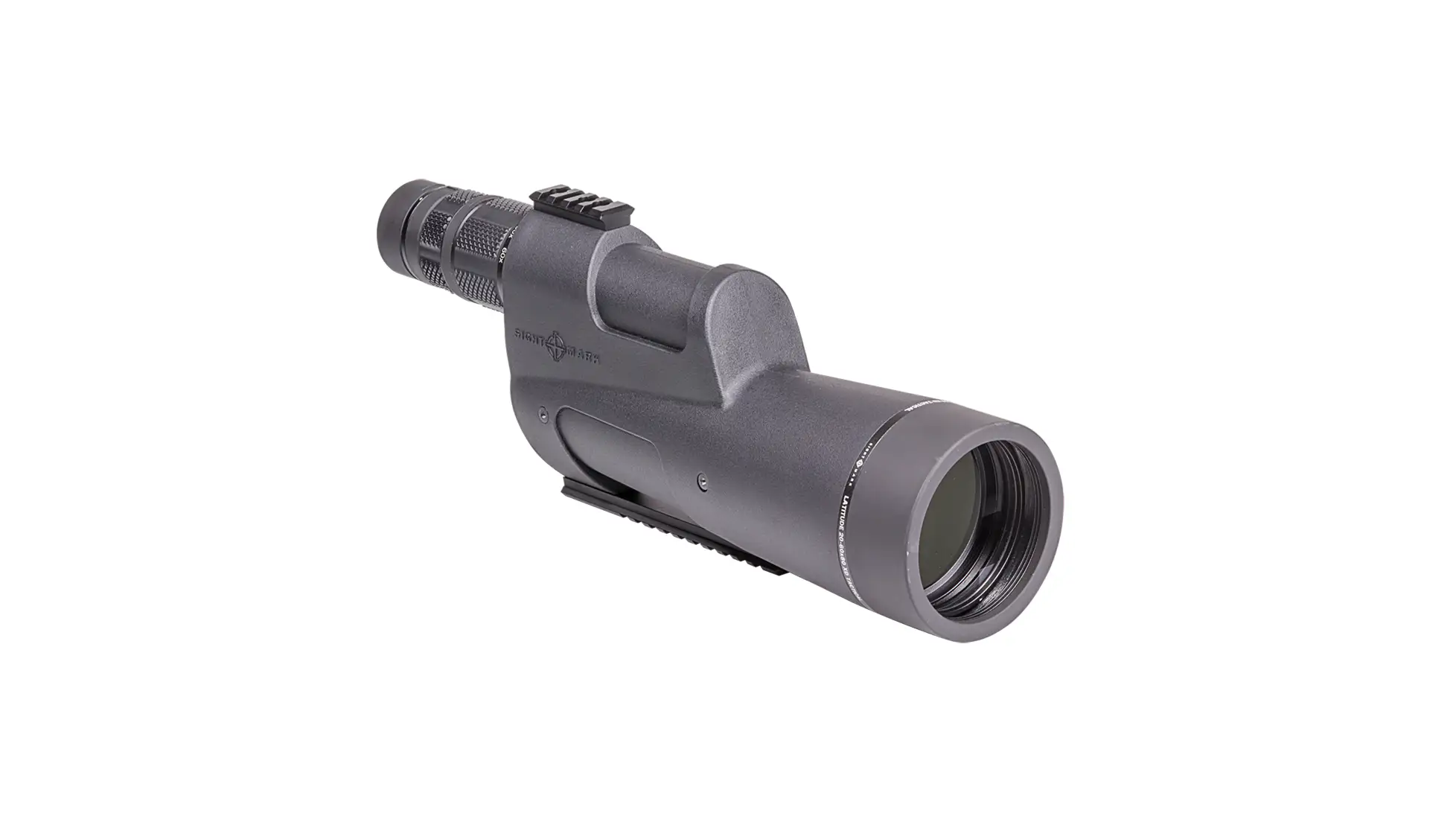
Best for calling corrections: Sightmark Latitude 20-60x80 XD Tactical Spotting Scope
20-60x · 80mm objective · first focal plane mil-hash reticle included · ED glass · dielectric-coated mirror system · IP67 · two Picatinny rails · 15.5 in · 67.7 oz
around $840exact price on OpticsPlanet
This is the pick because of one thing the others in its price bracket do not do: it puts a first focal plane mil-radian ranging reticle in the box for under $900. That combination is the entire reason a tactical spotter exists. When your shooter misses, you do not want to say "a bit left", you want to say "up 1.2, left 0.5", and only a reticle that matches the shooter's scope lets you do that. First focal plane matters just as much as the reticle itself: because the reticle scales with the image, one mil measured at 22x is still one mil at 45x, so you can dial magnification to fight mirage without redoing the maths. Reticle-equipped spotters normally start well above $1,500, and the two obvious alternatives make the point. The Vortex Razor HD needs a reticle eyepiece that costs almost as much again as this entire scope, and the Athlon Ares below needs a separate fixed-power eyepiece that costs you your zoom. RifleShooter magazine used this model out to 1,500 yards and called it "quite a bargain", though it said so when the scope sold for noticeably less than it does now, so weigh that verdict against the price on the card rather than the one the magazine saw. The 80mm objective is the largest here and it is what keeps the image usable when you dial up. Two things to go in with your eyes open about: the reticle needs verifying on arrival, and the weight is genuinely punishing. Both are in the cons, and the reticle issue is covered in detail further down the page.
Pros
- The cheapest way we found to get a first focal plane mil-hash ranging reticle in the box: the closest reticle-equipped alternatives are the pricier Athlon Cronus further down this page, or a Vortex Razor whose reticle eyepiece alone costs more than this whole scope
- The 80mm objective is the largest of the three picks, which is what keeps the image bright enough to stay useful in the 40x range where you actually read mirage and call wind
- RifleShooter magazine ran it out to 1,500 yards and wrote that they would be hard-pressed to ask for better performance at the price, and two OpticsPlanet owners report calling hits on steel out past 1,000 yards
- Genuinely tactical hardware, not just a tactical name: IP67 sealing, a rubber-armoured chassis, a twist-up eyecup with 26 to 27mm of eye relief for shooting glasses, and two Picatinny rails, the top one for a mini red dot that makes finding a target at 60x far quicker
Cons
- Verify the reticle before you trust it. An independent measured test published by The Firearm Blog in 2017 found a 34% reticle dimension error on its 20-60x80 sample and called that reticle useless for milling. The same testers found the smaller Sightmark 15-45 correct, so this looks like sample variance rather than a design fault, but it means a tall-target check on arrival is mandatory rather than optional
- At 67.7 oz and 15.5 in it is the heaviest and longest pick here, over 4 pounds, and it demands a genuinely heavy fluid-head tripod: at 60x a flimsy support turns every breath of wind into an unusable image
- The top of the zoom is a number more than a working magnification. An 80mm objective at 60x yields a 1.33mm exit pupil, which starves the eye and shrinks the eye box, so the practical working range is roughly 20x to 45x
- The reticle is not illuminated, which costs you against dark backdrops and in the last light of the day, and the owner record is very thin: 4 ratings, the most recent written in 2023
Best for: the precision rifle, PRS or F-Class shooter, or the spotter behind them, who needs to measure a miss and call a mil-based correction from a bench, a mat or a truck, and who does not want to spend four figures to get a reticle. Skip it if you carry your optic any distance, or if you want one scope that also does relaxed wildlife glassing: the weight and the reticle clutter both work against you there.
Key specifications
| Manufacturer | Sightmark (Sellmark) |
|---|---|
| Magnification | 20-60x |
| Objective lens | 80 mm |
| Reticle | First focal plane mil-hash, included in the box, not illuminated |
| Reticle detail | 1.0 mil increments upper and left, 0.5 mil lower and right to 11 mils |
| Glass | ED glass, fully multi-coated, dielectric-coated mirror system |
| Eye relief | 26 - 27 mm, twist-up eyecup |
| Exit pupil | 4.2 mm at 20x, 1.3 mm at 60x |
| Field of view | 131.1 - 43.5 ft at 1000 yds |
| Close focus | 39 ft (12 m) |
| Weight / length | 67.7 oz / 15.5 in |
| Sealing | IP67, nitrogen purged, O-ring sealed |
| Included | Two Picatinny accessory rails, lens covers, carrying case (no tripod) |
| Warranty | Sightmark limited lifetime, transferable, authorised-dealer purchase required |
“My spotter was able to walk me onto target with ease and my hits were clearly visible, even out to 2,000 yards. The spotting scope feels very rugged and the glass is extremely clear.”
Mikey K. via OpticsPlanet
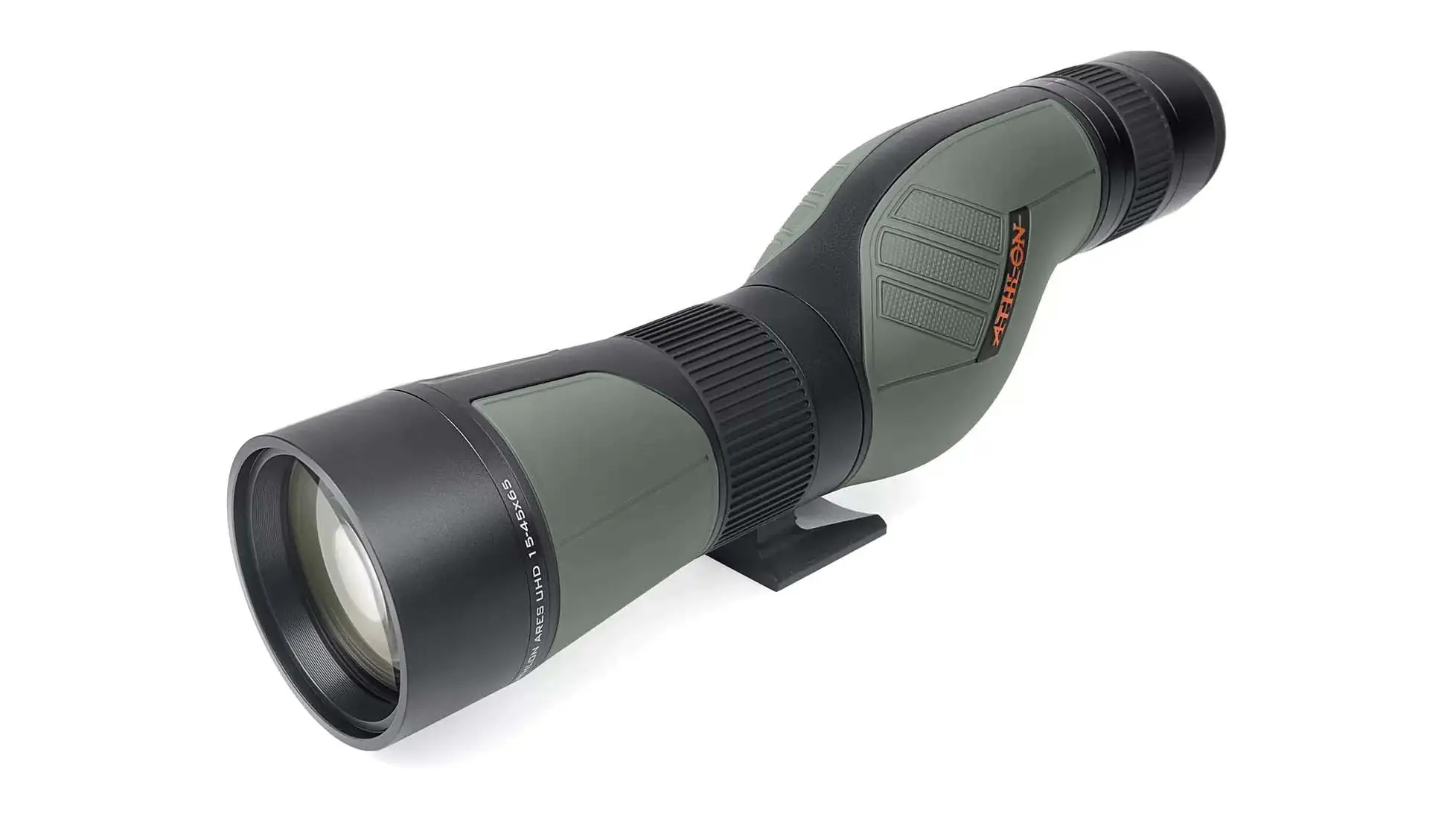
Best lightweight alternative: Athlon Optics Ares Gen II 15-45x65mm UHD Spotting Scope
15-45x · 65mm objective · ED glass · BAK4 with ESP dielectric coating · interchangeable eyepiece · built-in tripod adapter · 11.9 in · 50 oz
around $720exact price on OpticsPlanet
Buy this one if you have to carry your spotter to the firing point rather than lift it out of a truck. At 50 oz and 11.9 inches it is 18 oz lighter and three and a half inches shorter than our lead pick, and it has the best owner record here by some distance. What owners keep saying about it is that it punches far above its price: one compared it side by side with a Kowa TSN-88A and saw no discernible difference at 45x in good light, another set it next to a Vortex Razor 20-60x85 and called the glass as good or slightly better at half the money. Both are single-session owner impressions rather than controlled tests, but two independent people reaching for alpha-tier comparisons is a signal. Then comes the catch that decides its rank, and it is not a small one. The MIL ranging reticle this scope is credited with does not come in the box. OpticsPlanet's own product description says the reticle lives in a fixed 22 power eyepiece that is sold separately, and a verified owner confirms buying it and rates the combination highly. So getting a reticle here means a second purchase, and using it means giving up your zoom entirely and spotting at a fixed 22x. That is a real operational downgrade against a variable-power first focal plane system.
Pros
- By far the deepest owner record of the three picks, 4.9/5 across 9 ratings, with two separate owners comparing the glass favourably against a Kowa TSN-88A and a Vortex Razor 20-60x85
- The lightest and shortest pick here at 50 oz and 11.9 in, which makes it the only one of the three that is reasonable to walk any distance with
- ED glass with BAK4 prisms and ESP dielectric coating, an argon-purged full metal chassis, and a built-in tripod adapter that removes a common failure point
- The 15x low end is wider than the 20x of our lead pick, which makes finding a target and reading wind indicators across broad terrain noticeably faster
Cons
- The MIL reticle is not included. It sits in a fixed 22x eyepiece sold separately, so the reticle costs extra and using it means losing variable magnification altogether, which is the single reason this is not our top pick for calling corrections
- Usable sharpness runs out earlier than the spec sheet suggests: the most recent owner reports the image is clear from 15x to about 30x and softens beyond that, and he exchanged his for the Cronus
- Low-light performance is the weakest part of it. The owner review OpticsPlanet itself features as most helpful says the clarity and build are there but the low-light usefulness is not, and puts his practical working distance at 300 yards
- Two owners four years apart make the same complaint about the neoprene stay-on cover interfering with the focus wheel and the sun shade, so it is a design detail rather than a one-off unit fault
Best for: the range shooter who wants excellent glass per dollar in a body light enough to carry, and who is happy to spot without a reticle or to add the fixed 22x reticle eyepiece later. If calling mil corrections is the actual job, buy the Sightmark above instead: a reticle you own beats a reticle you might buy.
Key specifications
| Manufacturer | Athlon Optics |
|---|---|
| Magnification | 15-45x |
| Objective lens | 65 mm |
| Reticle | MIL, only via the fixed 22x eyepiece sold separately |
| Glass | ED glass, BAK4 prisms, ESP dielectric coating, advanced fully multi-coated |
| Eye relief | 19.1 - 16.0 mm |
| Exit pupil | 4.3 - 1.4 mm |
| Close focus | 13.1 ft |
| Weight / length | 50 oz / 11.9 in |
| Body | Straight (312004) or angled (312005), same price |
| Sealing | Argon purged, waterproof, fogproof, XPL exterior coating |
| Included | Standard variable-power eyepiece, stay-on cover (no tripod, no reticle eyepiece) |
“It seems well made and adjustments run smooth. Remains clear and sharp between 15x to about 30x, beyond that it seems to lose sharpness. The fixed 22x reticle eye piece with this scope is a great combo and is worth it just for that if you spend a lot of time at the range.”
CMS, verified owner via OpticsPlanet
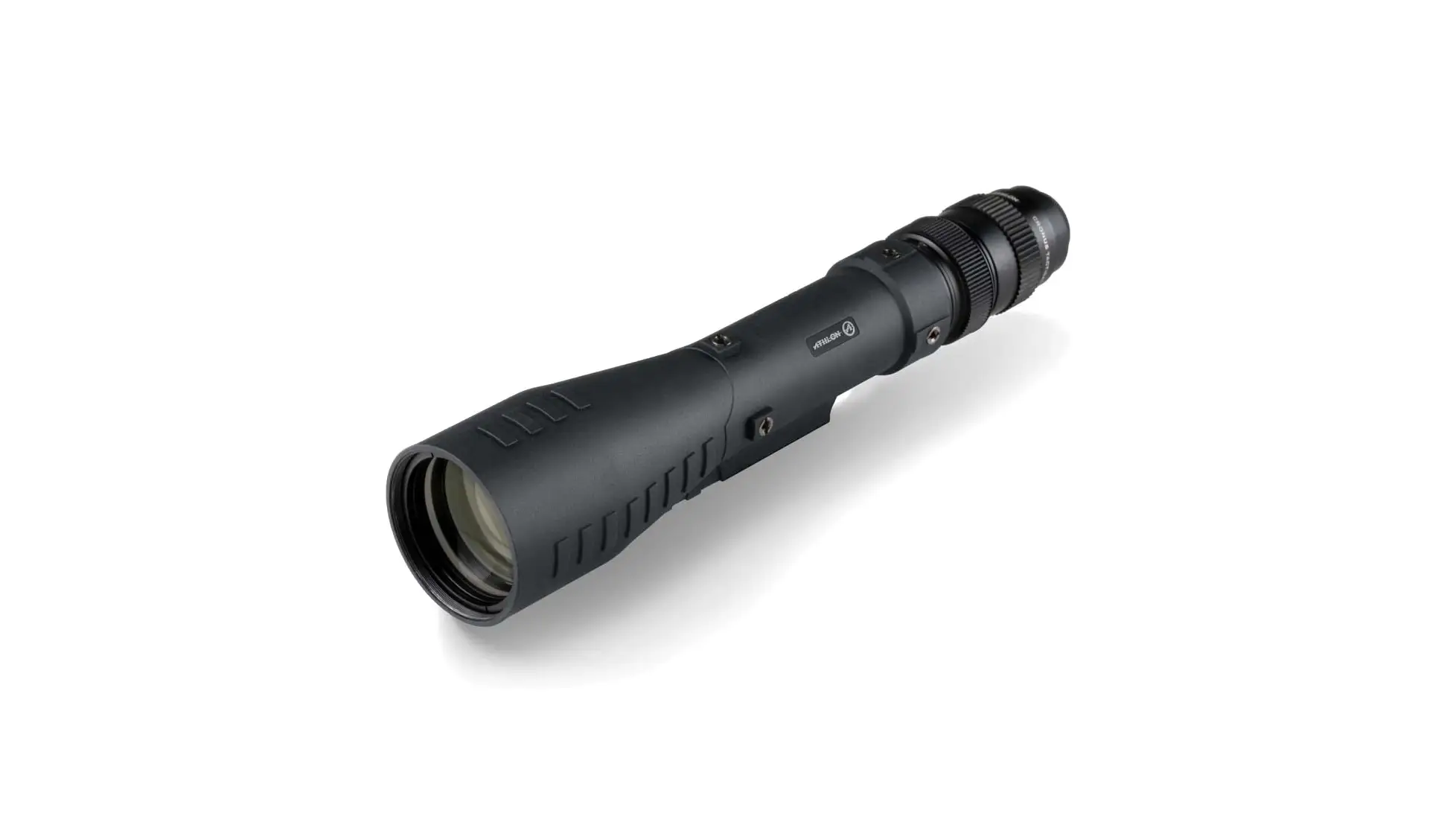
Premium step-up, no owner record yet: Athlon Optics Cronus G2 UHD 7-42x60 Tactical Spotting Scope
7-42x · 60mm objective · first focal plane ranging reticle included · UHD glass · apochromatic lens system · magnesium chassis · 13.9 in · 46.6 oz
around $1,100exact price on OpticsPlanet
This is the step-up to look at if the Sightmark's weight or its reticle-verification question puts you off, and it is on the page as a benchmark rather than a ranked buy. On paper it answers both objections: it is the lightest of the three at 46.6 oz despite being the most expensive, it carries an apochromatic UHD lens system rather than the merely ED glass below it, and its first focal plane ranging reticle is factory-fitted like the Sightmark's. Its real signature is the zoom range. Starting at 7x rather than 20x gives a genuinely wide field for finding targets and reading terrain before you punch in to 42x, which is a different and arguably better way to work than any 20-60x. There is also a quiet endorsement in our own research: the most recent Athlon Ares owner said he was exchanging his scope for the Cronus because it "isn't much more than the Ares and it's two eye pieces". Be clear on why it is ranked here and not higher. It has no owner reviews at all on OpticsPlanet, which means there is no independent record of how it performs or holds up, and our house rule is that we do not rank a product above ones with a real owner record on the strength of its spec sheet.
Pros
- The only pick here with both a factory-fitted first focal plane ranging reticle and the lightest body of the three at 46.6 oz, on a magnesium chassis
- An apochromatic UHD lens system, a tier above the ED glass in the other two picks, which is where colour fringing at high magnification actually gets solved rather than reduced
- The 7x low end is far wider than any 20-60x spotter, so finding a target and reading wind across broad terrain is much faster before you zoom to 42x
- Argon purged, waterproof, with a twist-up eyecup, rotating ring and 30mm of eye relief, the most generous here
Cons
- No owner reviews on OpticsPlanet at all, so there is no independent evidence of real-world performance or durability. This is the reason it is not ranked above the two picks that have one, and our score reflects verified specifications only
- The 60mm objective is smaller than the Sightmark's 80mm, which costs light exactly where a long-range spotter needs it, at the top of the zoom and at either end of the day
- It is the most expensive pick, roughly half as much again as the lightweight alternative above it, which is a lot to pay for a product with no owner track record, and OpticsPlanet's own spec table for it is unreliable: it lists a 42mm objective when the model is a 7-42x60
Best for: the buyer who wants a factory-fitted first focal plane reticle in the lightest possible tactical body, who values a very wide 7x low end for finding targets, and who is comfortable being an early adopter with no owner reviews to lean on. If you want proven glass, buy the Ares; if you want the reticle for the least money, buy the Sightmark.
Key specifications
| Manufacturer | Athlon Optics |
|---|---|
| Magnification | 7-42x |
| Objective lens | 60 mm (OpticsPlanet lists 42mm in error; the model is 7-42x60) |
| Reticle | First focal plane ranging reticle, included in the box |
| Glass | UHD glass, apochromatic lens system, XPL and ESP dielectric coatings |
| Eye relief | 30 mm, twist-up eyecup |
| Exit pupil | 1.43 - 5.2 mm |
| Chassis | Magnesium, argon purged, waterproof, rotating ring |
| Weight / length | 46.6 oz / 13.9 in |
| Body | Straight (311005) |
| Included | Spotting scope only (no tripod) |
What you can actually see at 1000 yards
This is the question the whole category is sold on, and most guides answer it with adjectives. There is measured data instead. An independent optical test by Finnaccuracy, published by The Firearm Blog in 2017, set up simulated bullet holes in five calibres and walked a group of reticle-equipped spotters back from 200 metres. The results are worth knowing before you spend $700.
| Distance | Sightmark 20-60x80 | Premium glass (Leupold Mk4, Hensoldt) |
|---|---|---|
| 200 m / 219 yds | All five calibres resolved | All five calibres resolved |
| 300 m / 328 yds | 7.62mm, barely | 6.5mm, but not 5.56mm |
| 400 m / 437 yds | .50 cal only | .338 only |
Read the right-hand column again. At 437 yards, optics costing several thousand dollars could not resolve a .308 hole in paper. That is not a failure of budget glass, it is mirage and atmosphere beating optics, and it is why the honest answer to "can I see bullet holes at 1000 yards" is no, at any price.
What you do see at 1000 yards is impact: paint spalling off steel, splash in a dirt berm, and bullet trace through the air. Every credible long-range report we found describes exactly that. Two OpticsPlanet owners of our lead pick report calling hits out to 2,000 yards, and RifleShooter magazine used it to 1,500 yards. Those are real and they are consistent with the physics, because none of them involve reading paper.
The practical consequence for buying: a bigger objective and a usable reticle are worth more to you at distance than a higher magnification number, which is why our picks are ranked on reticle and objective rather than on the top of the zoom range.
Check your reticle before you trust it
A ranging reticle is only worth having if its mils are really mils. The same 2017 Finnaccuracy test measured a 34% reticle dimension error on the Sightmark 20-60x80 sample they were sent and concluded the reticle was unfortunately useless for most purposes. Two things stop that being a reason to avoid the scope outright: the same testers measured the smaller Sightmark 15-45 reticle as correct, which points to unit variance rather than a line-wide design fault, and the test is now several years old.
But it is a very good reason to verify your own unit, and that is true of any budget tactical optic. The check takes ten minutes:
- Put a target of an exactly known size at an exactly known distance, for example a 12 inch square at 100 yards.
- Look through the scope and measure that target in mils against the reticle.
- Compare with the maths: one mil subtends 3.6 inches at 100 yards, so a 12 inch target should measure about 3.33 mils.
- If it reads meaningfully different, the reticle is miscalibrated. Return it rather than working around it.
A reticle that is off by a third does not fail obviously. It produces confident corrections that are wrong, which is worse than having no reticle at all. Ten minutes on arrival is cheap insurance.
How to choose a long range spotting scope
- Decide whether you truly need a reticle. If someone calls corrections for a shooter, nothing substitutes for it. If you glass game or read your own groups at 100 to 300 yards, a reticle just clutters the view and plain spotters give you better glass per dollar.
- Insist on first focal plane. An FFP reticle scales with the image, so a mil stays a mil at every magnification and you can zoom out to fight mirage without recalculating. All three picks here are FFP, but check any alternative carefully.
- Confirm the reticle is in the box. This is the trap in the category. The Athlon Ares needs a separately sold fixed 22x eyepiece, and a Vortex Razor reticle eyepiece costs more than our entire lead pick. A cheap scope plus a reticle eyepiece is often not cheap.
- Buy objective, not magnification. Exit pupil is objective divided by magnification, so an 80mm at 60x gives 1.33mm and a dim, fussy image. The bigger objective is what keeps 40x usable, which is where the work happens.
- Budget for a serious tripod. These are 3 to 4 pound levers. A pan-and-tilt fluid head, not a photo ball head, and nothing flimsy. See our best spotting scope tripods.
Not calling corrections for anyone? Our best spotting scopes for the money ranks plain spotters on glass per dollar, and gives you more optic for the same budget. Carrying it up a mountain? See best compact spotting scopes. Glassing for game? Best spotting scope for hunting ranks by low-light glass and pack weight instead.
FAQ
What is the best spotting scope for long range shooting?
The Sightmark Latitude 20-60x80 XD Tactical (under $900) is the best long range spotting scope for most shooters, because it is the cheapest way to get a first focal plane mil-hash ranging reticle in the box, which is what lets a spotter measure a miss and call an exact correction. Its 80mm objective is also the largest of our picks. If you need to carry it, the Athlon Ares Gen II 15-45x65 (under $750) is 18 oz lighter, cheaper and has a deeper owner record, but its MIL reticle requires a separately sold fixed 22x eyepiece, which is what closes that price gap again. The Athlon Cronus G2 UHD 7-42x60 (under $1,100) is the premium step-up with a factory reticle, though it has no owner reviews yet.
Can you see bullet holes at 1000 yards with a spotting scope?
No, and no spotting scope at any price can do it reliably. Independent measured testing published by The Firearm Blog in 2017 put paper-hole resolution in perspective: at 200 metres every scope tested resolved every calibre, at 300 metres the Sightmark 20-60x80 barely resolved a 7.62mm hole while premium Leupold and Hensoldt glass could still show 6.5mm, and at 400 metres the Sightmark showed only a .50 calibre hole. Beyond that, mirage and atmospheric distortion beat optics rather than glass quality. At 1000 yards you are reading impacts on steel, splash in a dirt berm, or bullet trace, and that is exactly what a ranging reticle is for.
Do you need a mil reticle in a spotting scope?
Only if someone is calling corrections for a shooter, but if that is the job then nothing else substitutes. Without a reticle a spotter can say a shot went left; with a mil-hash reticle they can say it went 0.5 mil left, which the shooter dials or holds directly. The reticle should be first focal plane, meaning it scales with the image, so a mil stays a mil at every magnification and you can zoom out to cut through mirage without redoing the maths. If you only glass for game, read your own groups at 100 to 300 yards, or watch wildlife, a reticle just clutters the view and you should buy a plain spotter instead.
How do you check a spotting scope reticle is accurate?
Use a tall-target test, and do it before you rely on the scope in a match. Measure a known object at a known distance, for example a 12 inch target at exactly 100 yards, then measure it through the reticle and compare. At 100 yards one mil subtends 3.6 inches, so a 12 inch target should read about 3.33 mils. This matters more on budget tactical spotters than on premium ones: the 2017 Firearm Blog test measured a 34% reticle dimension error on its Sightmark 20-60x80 sample while finding the smaller 15-45 model correct, which points to unit variance. A reticle that is off by a third is worse than no reticle, because it produces confident, wrong corrections.
What magnification do you need for 1000 yard shooting?
Less than the marketing suggests, because mirage sets the ceiling rather than the optics. Most spotters read wind and call impacts somewhere between 30x and 45x, and pushing to 60x on a hot afternoon usually just magnifies the heat shimmer into an unreadable boil. There is a physical limit too: exit pupil is the objective divided by magnification, so an 80mm scope at 60x delivers just 1.33mm of light to your eye, which dims the image and makes the eye box unforgiving. Treat the top of any zoom range as a peek at fine detail in good light, and buy for the objective diameter and the reticle rather than for the highest number on the tube.
Do long range spotting scopes come with a tripod?
None of the three picks here includes one, and with these scopes that omission costs more than usual. At 46.6 to 67.7 oz they are heavy, long levers that amplify every vibration, and at 40x and above a light travel tripod will visibly shake the image no matter how good the glass is. A pan-and-tilt fluid head is the right answer rather than a photo ball head, because you need to track and hold a target smoothly while calling shots. Budget for it alongside the scope, and see our best spotting scope tripods guide for options that suit these weights.
Related: best spotting scopes for the money · best compact spotting scopes · best spotting scope tripods · best long range rifle scopes.