The best compact spotting scopes in 2026
Our verdict for 2026: the Vortex Crossfire HD 12-36x50 (around $200) is the best compact spotting scope: 31.2 oz and 9.7 inches, about half the weight of a full-size 85mm spotter, with a built-in Arca-Swiss foot and a lifetime warranty. Want the sharpest image in the class and can carry 50.4 oz? Take the Diamondback HD 16-48x65 (around $400). The Crossfire HD 16-48x65 ($210) is the middle ground.
Between them the three picks carry 45 owner ratings on OpticsPlanet. Prices verified September 30, 2026; confirm the current price on the retailer page.
A compact spotting scope earns its place by being carried. Full-size 80 to 85mm spotters gather more light and reach further, but at 53 to 61 oz they get left in the truck, and an optic in the truck resolves nothing. The picks below are 50 to 65mm bodies chosen for what they give up and what they refuse to: real tripod hardware, honest zoom ranges and a lifetime warranty, at 31 to 50 oz.
How these picks were made: a research-based roundup comparing published specifications, owner reviews and live pricing on OpticsPlanet, plus a deep-research pass on the lead pick covering awards, optical trade-offs and competitors. Scores are our editorial opinion, not a hands-on test of every model, and owner ratings are shown attributed to their source. See how we evaluate.
Quick comparison
| Category | Pick | Spec | Price | |
|---|---|---|---|---|
| Best compact overall | Vortex Crossfire HD 12-36x50 Spotting Scope | 12-36x50 · 31.2 oz | around $200 | Check price |
| Best glass in the class | Vortex Diamondback HD 16-48x65mm Spotting Scope | 16-48x65 · 50.4 oz | around $400 | Check price |
| Best middle ground | Vortex Crossfire HD 16-48x65 Spotting Scope | 16-48x65 · 13.4 in | around $210 | Check price |
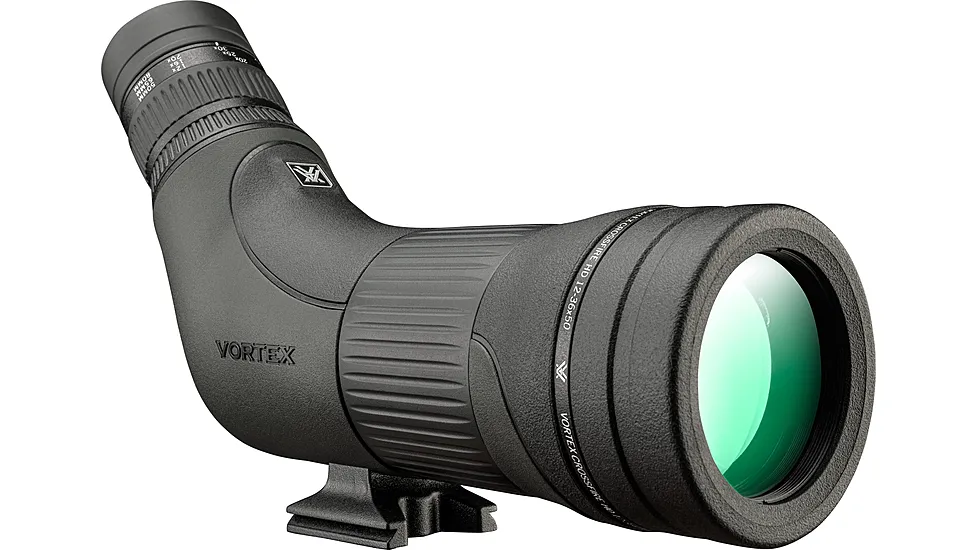
Best compact overall: Vortex Crossfire HD 12-36x50 Spotting Scope
12-36x · 50mm objective · HD optical system · built-in Arca-Swiss foot · tethered lens covers · neoprene stay-on case · 9.7 in · 31.2 oz · Vortex VIP lifetime warranty
around $200exact price on OpticsPlanet
This is the compact spotting scope to buy, because it is the one you will actually carry. At 9.7 inches and 31.2 oz it is about half the weight of a full-size 85mm spotter and short enough to ride in a pack side pocket, which is the entire point of the category: an optic left in the truck resolves nothing. What lifts it above the usual budget compact is the mechanical detail. The base is machined to the Arca-Swiss standard, so it drops straight onto a modern tripod head with no quick-release plate to twist loose, and the lens covers are tethered rather than the friction-fit caps you lose on day one. A neoprene stay-on case is in the box. Optically it is genuinely good where a 50mm should be good: a wide 173 ft field of view at 12x makes scanning a hillside fast, and the image holds up well through the low-to-middle magnification. Be clear on the two limits before you buy. It dims noticeably at dawn and dusk, and the top of the zoom is softer than the middle, which is covered in the cons.
Pros
- Genuinely packable at 9.7 in and 31.2 oz, roughly half the weight of a full-size 85mm spotter, so it fits a pack side pocket and gets carried
- A built-in Arca-Swiss foot mounts it directly to a modern tripod head with no adapter plate, which also lowers the centre of gravity and removes the classic single-screw plate twist
- A wide 173 ft field of view at 1000 yds at 12x makes finding and tracking things fast, and the image is sharp and bright through the low-to-middle magnification
- Tethered lens covers and a fitted neoprene stay-on case are included, and the Vortex VIP warranty is unlimited, unconditional and lifetime
Cons
- A 50mm objective gathers less light, so it dims well before an 80-85mm scope does: the first and last half hour of legal light is where this class gives up the most
- Usable image quality runs to roughly 30x; by the 36x ceiling owners and reviewers report softening and colour fringing, so treat the top of the zoom as a peek, not a working magnification
- Eyeglass wearers will struggle at maximum power. The 18 mm eye relief is fine on paper, but the exit pupil shrinks to 1.38 mm at 36x, and that tiny eye box is unforgiving of the extra distance glasses add (a limit of compact scopes generally, not a fault of this unit)
- The helical focus barrel is durable and snag-free but less fine than a dual-knob system, and twisting it nudges the tripod; the 50mm body also has no rotating collar, and no tripod is included
Best for: the backcountry or backpack hunter, hiker and casual range shooter who wants real magnification without the weight of a full-size spotter, glassing mostly in good light between 12x and 30x. Step up to a 65mm below if you glass at dawn and dusk, want to read impacts past 200 yards, or plan to digiscope.
Key specifications
| Manufacturer | Vortex |
|---|---|
| Magnification | 12-36x |
| Objective lens | 50 mm |
| Glass | HD optical system, fully multi-coated |
| Body | Angled (CF-50A) or straight (CF-50S) |
| Eye relief | 18 mm |
| Exit pupil | 4.16 mm at 12x, 1.38 mm at 36x |
| Field of view | 173 - 89 ft at 1000 yds |
| Close focus | 13.9 ft angled, 14.5 ft straight |
| Weight / length | 31.2 oz / 9.7 in |
| Mount | Built-in Arca-Swiss foot (no adapter plate needed) |
| Sealing | Waterproof, fogproof, nitrogen purged |
| Included | Neoprene stay-on case, tethered lens covers, lens cloth (no tripod) |
| Warranty | Vortex VIP: unlimited, unconditional, lifetime |
“I have a Vortex Diamondback 20-60x80 spotting scope. It is good for what it is, but it is really too large and heavy for what I primarily use it for... To my eye it is even sharper than the more expensive Diamondback it is replacing. The built in ARCA foot makes attaching to bipods a snap. If you are looking for a lite and handy spotter at an unbelievable price I highly recommend this one.”
verified owner via OpticsPlanet
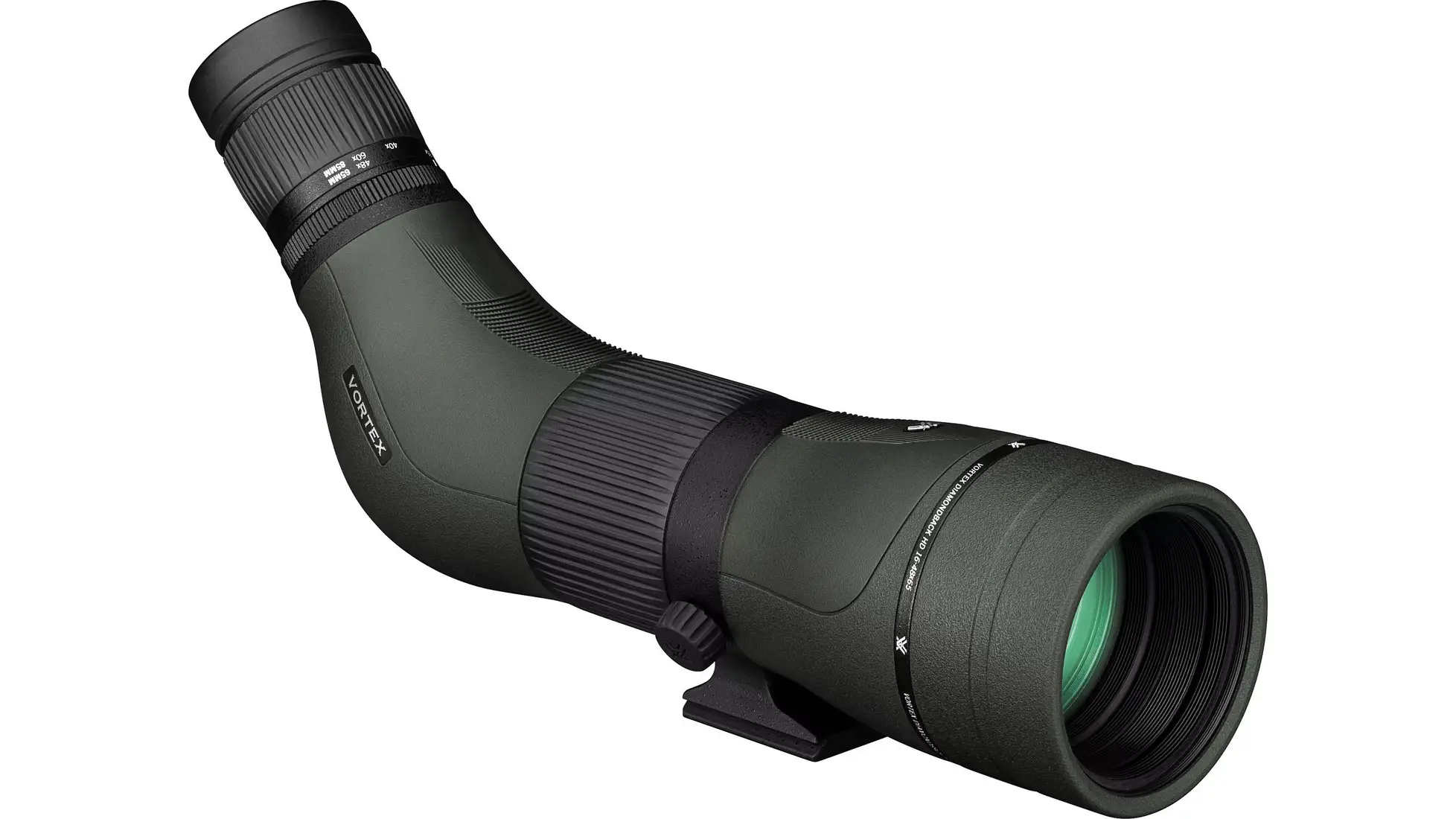
Best glass in the class: Vortex Diamondback HD 16-48x65mm Spotting Scope
16-48x · 65mm objective · HD glass · magnesium alloy chassis · rotating tripod ring · 13.75 in · 50.4 oz · Vortex VIP lifetime warranty
around $400exact price on OpticsPlanet
This is the pick when you want compact-class portability but refuse to give up image quality. The 65mm objective gathers far more light than a 50mm, the HD glass holds detail deep into the zoom, and owners specifically praise clarity at the top end rather than apologising for it, which is unusual at this price. The magnesium-alloy chassis and a rotating tripod ring let you turn the body to a comfortable eyepiece angle from a bench, a standing tripod or prone, a flexibility the 50mm body does not offer. It is also the pick if you want to digiscope: a verified owner reports very sharp digiscoped images through it, where a 50mm objective simply does not give a phone camera enough light. The trade is honest and physical. At 50.4 oz and 13.75 in it is over 60 percent heavier and four inches longer than our lead pick, which is why the retailer itself classes it as mid-size rather than compact.
Pros
- The best image here: 65mm of HD glass that owners describe as clear even at the top of the zoom, and the highest owner rating of any spotting scope we card (4.9/5)
- A rotating tripod ring lets you set the eyepiece angle for a bench, a standing tripod or a prone position, which the 50mm body cannot do
- The only pick here with a real digiscoping record: an owner reports very sharp phone photos through it, where a 50mm objective starves a phone camera of light
- Magnesium alloy chassis, waterproof and fogproof, with the same unlimited, unconditional Vortex VIP lifetime warranty
Cons
- At 50.4 oz and 13.75 in it is the heaviest pick here, over 60 percent heavier than the Crossfire 12-36x50, and the retailer classes it mid-size rather than compact
- Nearly twice the price of our lead pick, which is a lot for glass you may only exploit in good light or on a tripod
- Still not a low-light champion: an owner notes clarity in very low light is not its strength, since 65mm gathers less light than the 85mm class
- No tripod is included, and at this weight a flimsy travel tripod will visibly shake the image
Best for: the hunter or shooter who wants the sharpest image they can get while still staying under the size of a full-size spotter, who glasses from a pack-in position or a bench rather than deep backcountry, and who wants to digiscope. If ounces are your constraint, buy the Crossfire HD 12-36x50 instead.
Key specifications
| Manufacturer | Vortex |
|---|---|
| Magnification | 16-48x |
| Objective lens | 65 mm |
| Glass | HD lens elements, fully multi-coated |
| Body | Angled (DS-65A) or straight (DS-65S) |
| Chassis | Magnesium alloy with rubber armour |
| Weight / length | 50.4 oz / 13.75 in |
| Sealing | Waterproof, fogproof |
| Included | Lens covers, case (no tripod) |
| Warranty | Vortex VIP: unlimited, unconditional, lifetime |
“As you would expect, this product lives up to the Vortex reputation. I like the position-able angled eye-piece. It is comfortable to place on a bench, on a standing tripod, or even on a low-profile tripod next to you when solo and prone. Love it.”
Chris, verified owner via OpticsPlanet
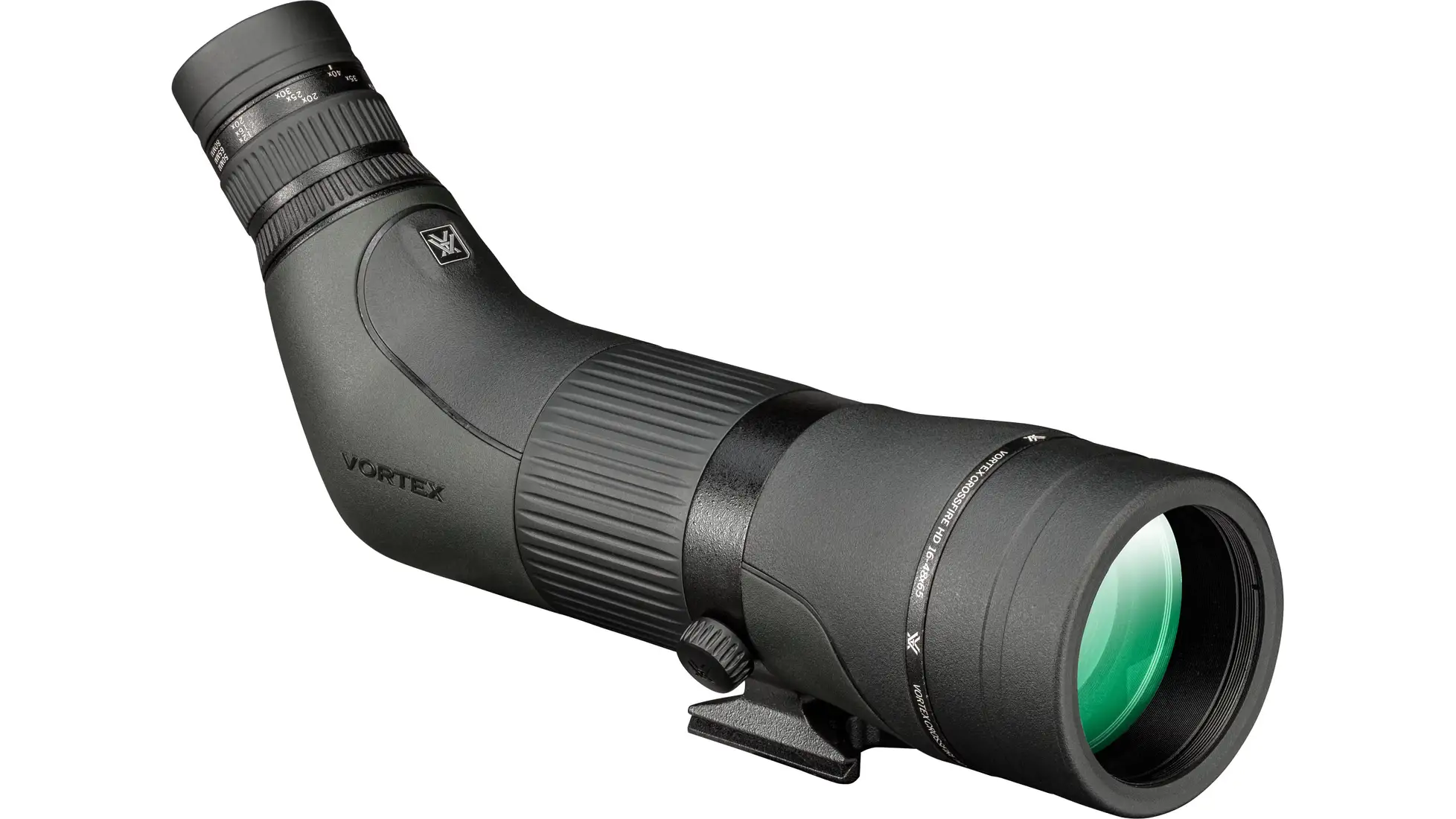
Best middle ground: Vortex Crossfire HD 16-48x65 Spotting Scope
16-48x · 65mm objective · HD optical system · built-in Arca-Swiss foot · 18 mm eye relief · 13.4 in · Vortex VIP lifetime warranty
around $210exact price on OpticsPlanet
This is the bridge between the two picks above: the extra light and reach of a 65mm objective for about $150 less than the Diamondback, on the same Crossfire chassis with the same built-in Arca-Swiss foot. The most useful thing owners say about it is not about sharpness but about the zoom range. One buyer who had already been burned by two cheaper spotters, one with a misaligned tube and one with heavy colour fringing and an unusable 60x, calls 16-48x the goldilocks range: by refusing to advertise a 60x it cannot deliver, this scope spends its glass on magnifications you will actually use. That matches what we found testing budget 20-60x spotters, whose top end is largely decoration. One caveat keeps it out of the top spot: the owner record is small and entirely positive, so there is no long-term durability picture yet. We card the angled body (CF-65A); the straight body (CF-65S) carries the same price if you prefer that layout.
Pros
- A 65mm objective and the same built-in Arca-Swiss foot as our lead pick, for about $150 less than the Diamondback HD
- The 16-48x range is honest rather than inflated: an owner who had returned two cheaper 20-60x spotters calls this the goldilocks zoom, with minimal colour fringing
- Rated 5.0/5 by its owners so far, who single out clarity for reading shot groups at range
- Waterproof, fogproof and shock resistant with the unlimited, unconditional Vortex VIP lifetime warranty
Cons
- The owner record is thin and one-sided: 12 ratings with no critical reviews at all, so there is no long-term reliability picture yet
- At roughly 44 oz it is about 40 percent heavier than the Crossfire HD 12-36x50, which spends a good part of the packability you came to this page for
- Glass sits below the Diamondback HD: this is the Crossfire tier, so expect good rather than excellent performance at the top of the zoom
Best for: the buyer who wants 65mm light-gathering without paying Diamondback money, glassing from a truck, blind or bench where the extra weight does not matter much. Go lighter with the Crossfire HD 12-36x50, or sharper with the Diamondback HD 16-48x65.
Key specifications
| Manufacturer | Vortex |
|---|---|
| Magnification | 16-48x |
| Objective lens | 65 mm |
| Glass | HD optical system, fully multi-coated |
| Body carded | Angled (CF-65A); a straight body (CF-65S) is listed at the same price |
| Eye relief | 18 mm |
| Field of view | 131 - 68 ft at 1000 yds |
| Close focus | 16.5 ft |
| Length | 13.4 in |
| Mount | Built-in Arca-Swiss foot |
| Sealing | Waterproof, fogproof, shock resistant |
| Warranty | Vortex VIP: unlimited, unconditional, lifetime |
“Minimum chromatic aberration, usable zoom range - most scopes of this aperture get a 20-60x zoom but this is the goldie locks zoom range... If you are looking for a smaller, portable, good quality spotter at reasonable price, this is the one to buy.”
verified owner via OpticsPlanet
What compact actually costs you
Two things, both physical, and neither of them fixable by spending more inside this class.
Light. A smaller objective gathers less of it. That is invisible at midday and decisive at dawn and dusk, which is exactly when game moves, so a compact scope gives up the first and last half hour of usable light to a full-size one. It is the single reason to buy an 80 to 85mm body instead.
The top of the zoom. Magnification shrinks the exit pupil, the cylinder of light leaving the eyepiece, because it equals the objective divided by the magnification. On a 50mm scope that is a comfortable 4.16 mm at 12x but only 1.38 mm at 36x. A 1.38 mm exit pupil makes the eye box tiny and unforgiving, which is why the image looks dim and fussy at maximum power and why eyeglass wearers lose the edges of the view there. This is why we rate the class on its usable middle, roughly 12x to 30x, rather than on its headline number.
| Body | Objective | Weight | Length | Price |
|---|---|---|---|---|
| Crossfire HD 12-36x50 | 50 mm | 31.2 oz | 9.7 in | around $200 |
| Crossfire HD 16-48x65 | 65 mm | ~44 oz | 13.4 in | around $210 |
| Diamondback HD 16-48x65 | 65 mm | 50.4 oz | 13.75 in | around $400 |
| Diamondback HD 20-60x85 (full size) | 85 mm | 61.3 oz | 16 in | under $550 |
The full-size row is our best spotting scope for the money pick, shown for scale: it is double the weight of our lead pick here.
How to choose a compact spotting scope
- Decide where it lives. In a pack, take the 50mm and its 31 oz. In a truck, blind or on a bench, a 65mm buys you light and reach for weight you will not feel.
- Ignore the headline magnification. A 16-48x that is sharp to 40x beats a 20-60x that falls apart at 45x. Budget scopes advertising 60x are selling you a number, as one owner here found after returning two of them.
- Check the foot before the glass. A built-in Arca-Swiss foot, which both Crossfire models have, mounts directly to a modern tripod head: no plate to buy, nothing to twist loose under a lever-shaped optic.
- Budget for the tripod. None of these includes one, and a shaky tripod ruins good glass faster than mediocre glass does. See our best spotting scope tripods.
- Wear glasses, or want to digiscope? Both push you toward a bigger objective. Phones need light a 50mm cannot spare, and the eye box at maximum power on a 50mm is unforgiving of eyeglasses.
Glassing mostly from a bench or truck, or want maximum reach for the money? See our best spotting scopes for the money. Hunting with it? Our best spotting scope for hunting ranks by low-light glass and pack weight. Not sure you need a scope at all? Read spotting scope vs binoculars. Want a compact Razor? Our Vortex Razor HD 13-39x56 review covers a 56 mm spotter that Vortex lists at 28.6 oz in the angled body; it is not one of the picks on this page.
FAQ
What is the best compact spotting scope?
The Vortex Crossfire HD 12-36x50 ($200) is the best compact spotting scope for most buyers: at 9.7 inches and 31.2 oz it is about half the weight of a full-size 85mm spotter, it mounts straight to a tripod on a built-in Arca-Swiss foot with no adapter plate, and it carries the unlimited Vortex VIP lifetime warranty. If you want the sharpest image in the class and can accept 50.4 oz, the Vortex Diamondback HD 16-48x65 ($400) is the better glass, and the Vortex Crossfire HD 16-48x65 ($210) sits between them.
How much magnification do you lose with a compact spotting scope?
Less than the numbers suggest, because the top of any budget zoom is the weakest part of it. A compact 50mm tops out around 36x and a 65mm around 48x, against 60x on a full-size scope, but owners and reviewers consistently report that image quality on this class of scope holds to roughly 30x and then softens, with colour fringing creeping in at the ceiling. In practice you lose the last, dimmest slice of magnification rather than the usable middle, which is where nearly all spotting actually happens.
Can you use a compact spotting scope with glasses?
At low and middle magnification yes, at maximum magnification often not. Eye relief tells only half the story: the exit pupil, which is the objective diameter divided by magnification, sets how forgiving the eye box is. On a 50mm scope it falls from 4.16 mm at 12x to just 1.38 mm at 36x, and that tiny cylinder of light is unforgiving of the extra distance glasses put between your eye and the eyepiece, so you get vignetting or a tunnel view. One owner of our lead pick reports exactly that at high power despite its 18 mm eye relief. This is a characteristic of compact scopes at maximum zoom rather than a defect, and the same complaint is documented on comparable 60mm scopes from other brands. If you wear glasses, plan to work at lower magnification, or choose a larger objective.
Is a 50mm or a 65mm compact spotting scope better?
It depends on when you glass and how far you carry it. A 50mm like the Crossfire HD 12-36x50 wins outright on portability at 31.2 oz, and is enough to find game, judge antlers and read hits on paper at 100 to 200 yards in good light. A 65mm gathers noticeably more light, which matters at dawn and dusk and when you push magnification, and it is the practical minimum for digiscoping with a phone, but it costs you weight: the Diamondback HD 16-48x65 is 50.4 oz. If it lives in a pack, take the 50mm; if it lives in a truck, blind or bench, take a 65mm.
Do compact spotting scopes come with a tripod?
None of the three picks here includes one, and that is a real part of the budget. A spotting scope is longer and heavier than a camera, so it acts as a lever that amplifies every wobble, and a flimsy travel tripod will shake the image at high magnification no matter how good the glass is. The Crossfire models make this cheaper to solve: their built-in Arca-Swiss foot drops straight into an Arca head with no quick-release plate to buy or twist loose. See our best spotting scope tripods guide for picks that suit these weights.
Related: best spotting scopes for the money · best spotting scopes for long range shooting · best spotting scope tripods · best binoculars for hunting.