Hornady 366 Auto review: the progressive shotshell reloader
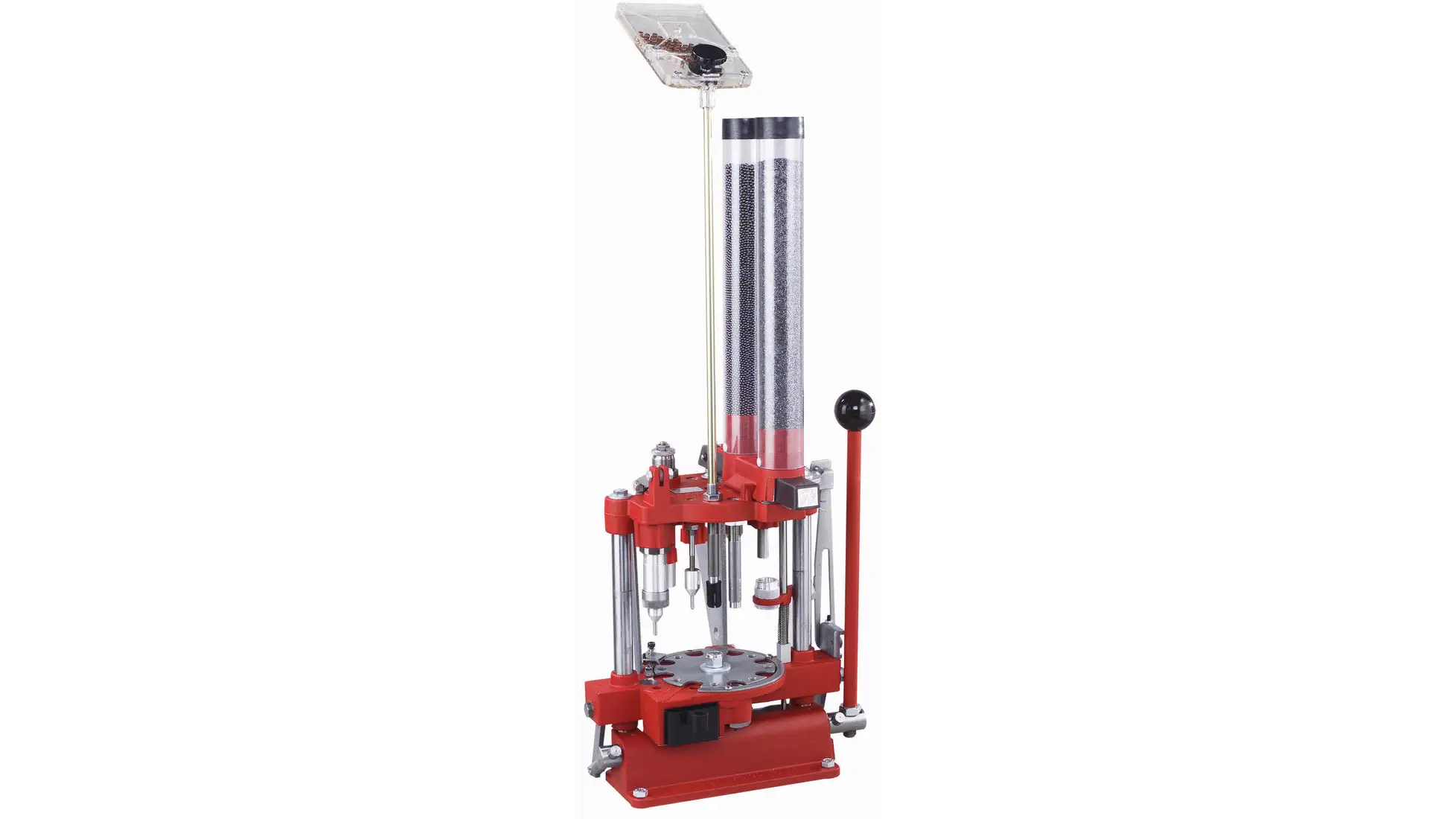
Our verdict: 4.4/5. The Hornady 366 Auto is a progressive shotshell press for trap, skeet and sporting clays shooters who load in volume. You set an empty hull and a wad, pull the handle, and the shell plate indexes itself through resizing, priming, powder, wad, shot and a three-stage crimp; Hornady's manual says that once the first cycle is completed, it kicks out a finished shell with every stroke. It loads shotshells only, not rifle or pistol cartridges. OpticsPlanet reviewers praise the build and the separate powder and shot shutoffs. The catches are the price, a primer feed shutoff that Hornady sells as a separate part, and a shell that two owners say cannot simply be lifted out mid-cycle (Hornady's manual takes one out by lifting the indexing pawl). Hornady backs it with its No-Risk, Lifetime Warranty, with exclusions. For rifle and pistol ammunition, see our best reloading press guide.
OpticsPlanet shoppers rate it 4.7/5 from 7 reviews. We card the 12 gauge row (Hornady item 010041) at around $1,500. Check price and availability on OpticsPlanet.
How we reviewed it: a research-based review built from Hornady's own sources: the 366 Auto product page, the 366 Auto Dies and Shotshell Accessories pages, two Hornady support answers (Winchester AA hulls and the reloading tools warranty) and Hornady's 366 Auto operation manual in its 2010 edition, the version we could read. We add the OpticsPlanet listing and all 7 of its reviews. We have not used this press ourselves; the score is our editorial opinion and the owner rating is shown attributed to its source. Claims from outside research that we could not confirm at Hornady, such as a shells-per-hour figure and the press's weight, are left out. This page publishes no load data. See how we evaluate.
How the 366 Auto works, station by station
A single stage shotshell press does one step per pull and you move the shell yourself. On the 366 Auto, Hornady says each pull of the lever automatically rotates the shell plate, and once the press is full, the manual says, you have a shell at each station. The manual says the shell advances on the return stroke, and that completed shells are ejected behind the press. Your job on each stroke is to set a new hull at the start, drop a wad in the wad guide, and keep the tubes filled.
| Station | Job | What Hornady says about it |
|---|---|---|
| 1A | Resize and deprime | The size die sizes the brass head and rim "to permit the chambering of that shell in any firearm" (manual). Hornady says you can skip this station to speed up reloading. |
| 1 | Deprime only | If you bypass Station 1A, a shell must still be in place here before you pull the handle, or there is a gap in the reloading sequence (manual). |
| 2 | Prime | The primer feeds automatically and is seated by the primer punch; the manual says it should sit flush with the case head. |
| 3 | Powder drop | A fixed bushing throws the charge; the manual says there is no adjustment to the powder drop. The powder slide turns it on and off. |
| 4 | Wad seating | You drop a wad into the swing-out wad guide; plastic spring fingers hold the case mouth open (Hornady). |
| 5 | Shot drop | A shot bushing throws the shot; the shot rotor turns it on and off. No adjustment is possible here (manual). |
| 6 | Crimp start | Comes with the eight point crimp starter installed; a six point and a smooth starter for paper are included (manual). |
| 7 | Crimp | Two adjustments, the die body and the crimp plunger, set by the number of threads exposed above the locking nut for each brand of hull (manual). |
| 8 | Taper crimp | Tapers the case mouth; on the return stroke the finished shell drops through a hole in the platen and down a chute to the back of the press (manual). |
Station names and descriptions are from Hornady's 366 Auto operation manual (2010 edition) and the 366 Auto product page. The manual says the press was pre-adjusted at the factory for Remington STS cases, so other hulls may need changes.
Hornady's product page lists the features behind that sequence: an automatic primer feed whose Primer Tube Filler holds a full box of shotshell primers and, per Hornady, will not drop primers upside-down into the feeder tube; powder and shot hopper tubes whose entire assembly comes off without spilling, which Hornady calls a feature unique to the 366 Auto; a swing-out wad guide; and 3-stage Taper-Loc crimping that, in Hornady's words, "reliably starts a crimp, closes and tapers for both six- and eight-point crimps".
What the 7 OpticsPlanet reviews say
The listing shows 7 reviews from 6 reviewers: one reviewer, Don, posted the same text twice. Five of the 7 are five stars (Don's two copies among them) and two are four stars. Four of the six reviewers carry a Verified Owner tag. The reviews sit on a listing shared by all four gauges, and most do not say which gauge they own; one names a 20 gauge 366 and an older 12 gauge one, another loads 12 gauge. With a pool this small, read these as individual experiences, not a pattern.
The praise is for build and operation. An untagged reviewer who compares its castings with their RCBS Rockchucker press lists one pro:
“Very high build quality”
Trap shooter (IL), five-star review from May 2026, via OpticsPlanet
The same reviewer calls the powder and shot shutoffs essential for starting out or finishing the shells on the turntable. A Verified Owner who also runs MEC loaders lists, among the 366's strengths, that it "has powder & shot cut off systems" and a "superior primer feed design". Don's one-line review:
“Excellent reloader, one minor adjustment to be made to powder bushing”
Don (TX), Verified Owner, five-star review from April 2025, via OpticsPlanet
Another untagged reviewer, KCMO, writes that it "sure makes a lot of 12 gauge quickly". The catches come from five-star and four-star reviews alike, and the next section takes them one by one.
The honest catches
Price. This is an expensive press for shotshells. The Trap shooter review lists a single con:
“Higher starting price than MEC.”
Trap shooter (IL), five-star review from May 2026, via OpticsPlanet
The primer feed shutoff is a separate part. The press comes with separate powder and shot shutoffs: Hornady's manual has you push in the powder slide and pull the shot rotor forward. A primer feed shutoff is not part of that. Hornady's Shotshell Accessories page lists the Primer Feeder Shutoff, item 010053, to independently shut off the primer feed tube instead of removing it, and says it "Can be retrofitted to nearly any 366 Auto". Ding Witherspoon, a Verified Owner, makes the same point in their own words: "primer shutoff off system only available as $$ upgrade".
A shell is not easy to take out mid-cycle. Two owners raise it. Ding Witherspoon writes that the 366 "can not remove shell once operation has started", and CD, also a Verified Owner, writes:
“you cant remove the shells at each station”
CD (TX), Verified Owner, five-star review from April 2024, via OpticsPlanet
That is the owners' experience, not a hard limit. Hornady's manual (2010 edition) does take a shell out: to remove a primed case and inspect the primer, it says to lift the pawl from the indexing position and rotate the shell plate back to station one, and its troubleshooting steps say not to force the handle but to shut off the powder and shot and unlatch the rotating pawl. CD describes modifying their older 12 gauge 366 to remove the shell at the powder drop. Before you modify yours, note that Hornady's warranty is void if the product has been altered.
Crimp adjustment can mean taking parts off. CD writes that they had to adjust the final crimp on their 20 gauge, and that it is a pain because the deprimer and drop tubes have to come out to reach the locking nut. Hornady's Shotshell Accessories page lists no special wrench for it. That is one owner's report.
Shipping damage happens. Ronald Race, a Verified Owner, gave four stars instead of five because "the shot hopper was cracked, and one of the hopper rivets was missing". The same review ends:
“I wrote to Hornady, and replacement parts were shipped.”
Ronald Race, Verified Owner, four-star review from December 2024, via OpticsPlanet
Hornady's manual also says not to return the loader to your dealer, and to contact Hornady directly with a problem.
Trade-offs, plainly
- Expensive for a shotshell press; one reviewer's only con is the higher starting price than MEC.
- The primer feed shutoff is a separate Hornady part (item 010053); powder and shot shutoffs are built in.
- Two owners say a shell cannot simply be removed mid-cycle; Hornady's manual removes one by lifting the pawl and rotating the plate back.
- One owner found reaching the final crimp locking nut a chore.
- It loads shotshells only, one gauge at a time; another gauge needs a 366 Auto die set and a re-setup.
- Hornady publishes no shells-per-hour figure and no weight, so plan bench space from your own measurements.
- Seven reviews in total, from six reviewers, so the owner record is thin.
Setup, hulls and bushings
Mounting. The manual says to mount the 366 Auto securely toward the front of a sturdy bench, with the handle clearing the bench in the down position. Because shells drop out the back, it suggests Hornady's riser blocks (item 010060, sold as Riser Legs, 4 per package) or a hole in the bench with a box underneath.
Hulls. The press comes set for Remington STS cases (manual). For the new Winchester AA hulls, Hornady's support answer says to raise Station 7 to take the pressure off the case, usually two complete turns, and that around 10 to 11 turns will work for the new AA cases; if a small hole is left in the center, adjust Station 6 down.
Bushings. Powder and shot are thrown by fixed bushings, not an adjustable measure. Hornady says its powder bushing numbers match the inside diameter (the #456 bushing is .456 inches), and that its powder bushing chart should be used only for the 366 Auto and Hornady's APEX. Hornady also sells shot bushings "Calibrated to measure maximum legal loads for trap and skeet shooting", plus field load and steel shot series. The 2010 manual names a 468 powder bushing as the standard 12 gauge bushing, and tells you to double check that you dispense the correct weight of powder and shot. Use a current shotshell reloading manual from a powder or component maker for the load itself; this page gives none.
Running it. The manual's advice: operate the handle smoothly, and only as fast as primers will reliably drop; and if you refill the primers, shot and powder after each 100 rounds, you will never load shells without components.
Extras Hornady lists. Crimp starters (six point, eight point and paper for 12 ga; six and eight point for 20 ga; six point for 28 ga), a Spring Loaded Primer Seater (item 010051, 12 or 20 gauge) that saves readjusting the punch for different brands of hulls, and a 2 ft Tube Hopper (item 490001) that Hornady says has nearly twice the volume of its standard hoppers.
Which gauge to buy
The OpticsPlanet listing has four new rows, one per gauge, and each is its own press. Hornady's item numbers: 12 ga, 010041, the row the listing shows and the one we card; 20 ga, 010044; 28 ga, 010046; and .410, 010047. The 20 ga, 28 ga and .410 rows sell at their own prices, so check the gauge you shoot on the listing before you order. Hornady also lists 12 ga and 20 ga versions with optional Gas Assist (items 010050 and 010052); this page does not describe them.
If you shoot more than one gauge, Hornady sells 366 Auto die sets, and its manual describes the conversion: adjust the full length size die first, then install the other dies and punches using the size die as a guide, and adjust each station by actually reloading a shell.
12 ga, Hornady item 010041: around $1,500. The 20 ga, 28 ga and .410 rows are on the same listing at their own prices.
Warranty
Hornady covers its reloading tools with a No-Risk, Lifetime Warranty against material defects and workmanship for the life of the product. Hornady's own summary: "if it breaks, we'll repair it or replace it at no charge (at Hornady Manufacturing Company's option)". It is not unconditional. Hornady says the warranty is void if the product has been damaged by accident or unreasonable use, has been altered or repaired by anyone other than authorized factory personnel, is used commercially, or has been defaced. Claims start with Hornady customer service, which must assign a Return Authorization number before you send anything.
Key specifications
| Spec | Hornady 366 Auto, 12 ga |
|---|---|
| Type | Progressive shotshell reloading press with automatic indexing (Hornady) |
| Carded row | 12 ga 2 3/4 in, Hornady item 010041 (OpticsPlanet row title "12ga 2 3/4in.") |
| Stations | 1A plus 1 to 8: resize and deprime, deprime only, prime, powder, wad, shot, crimp start, crimp, taper crimp (2010 manual) |
| Resizing | Full-length resizing station, can be skipped (Hornady) |
| Priming | Automatic primer feed; Primer Tube Filler included (Hornady) |
| Shutoffs | Powder slide and shot rotor (manual); primer feed shutoff sold separately, item 010053 (Hornady) |
| Charges | Fixed powder and shot bushings; bushing number = inside diameter (Hornady) |
| Crimp | 3-stage Taper-Loc for six- and eight-point crimps; eight point starter installed, six point and paper starters included (Hornady, manual) |
| Ejection | Automatic, behind the press (Hornady) |
| Factory setting | Remington STS cases (2010 manual) |
| Other gauges | 20 ga 010044, 28 ga 010046, .410 010047 (Hornady) |
| Warranty | Hornady No-Risk, Lifetime Warranty, with exclusions (see above) |
| Price (OpticsPlanet, 12 ga) | around $1,500 |
OpticsPlanet's own spec table lists only the manufacturer, quantity and condition, so every figure above is Hornady's. Hornady publishes no weight, dimensions or shells-per-hour figure for the 366 Auto, and no editorial award is claimed.
Should you buy it?
- Buy it if you shoot trap, skeet or sporting clays often enough that loading shells is a weekly chore, and you want one pull per finished shell once the press is full.
- Add the primer feed shutoff (Hornady item 010053) if you want to stop priming without pulling the primer tube.
- Skip it if you load a few boxes a year, if you want to pull a shell off any station at will, or if you were hoping for one press that also loads rifle and pistol cartridges: the 366 Auto loads shotshells only.
What else to consider:
- For rifle and pistol ammunition, our Hornady Lock-N-Load AP pick is Hornady's five-station progressive for metallic cartridges; it does not load shotshells.
- For a first metallic press, the Lee Classic Turret Press Kit is that guide's overall and starter pick, with a powder measure, priming and case prep in the kit.
- For the line itself, our hearing protection for shooting guide covers muffs, including thin-cup designs it recommends for outdoor rifle and shotgun shooting.
FAQ
Is the Hornady 366 Auto worth it?
It is worth it if you shoot enough trap, skeet or sporting clays to reload in volume. It is a progressive press: Hornady's manual says that once the first cycle is completed, it kicks out a finished shell with every stroke, and Hornady describes it as ideal for the avid target shooter. It is expensive, the primer feed shutoff is a separate Hornady part, and two owners say a shell cannot simply be pulled out at any station (Hornady's manual removes one by lifting the indexing pawl). In our opinion, if you load a few boxes a season, a simpler single stage shotshell press is the more sensible buy.
How many stations does the Hornady 366 Auto have?
Hornady's 366 Auto operation manual (2010 edition) lists Station 1A (resize and deprime) and Stations 1 through 8: deprime only, prime, powder drop, wad seating, shot drop, crimp start, crimp and taper crimp. The finished shell is then ejected down a chute to the back of the press. Hornady's product page says you can resize to factory dimensions or skip the resizing station to speed up reloading.
Does the Hornady 366 Auto have a primer shutoff?
It has separate powder and shot shutoffs: the manual has you push in the powder slide and pull the shot rotor forward. A primer feed shutoff is a separate part. Hornady lists the Primer Feeder Shutoff, item 010053, to independently shut off the primer feed tube instead of removing it, and says it can be retrofitted to nearly any 366 Auto. One OpticsPlanet owner raises the same point.
Can you remove a shell from the Hornady 366 Auto in the middle of a cycle?
Not by simply pulling it off a station, according to two OpticsPlanet owners: one writes that you can not remove a shell once operation has started, the other that you cannot remove the shells at each station. It is not impossible, though. Hornady's 366 Auto manual (2010 edition) describes a way: to remove a primed case and inspect the primer, lift the pawl from the indexing position and rotate the shell plate back to station one. Its troubleshooting steps also tell you to shut off the powder and shot and unlatch the rotating pawl rather than force the handle.
What warranty does Hornady give on the 366 Auto?
Hornady covers its reloading tools with a No-Risk, Lifetime Warranty: Hornady says that if it breaks, it will be repaired or replaced at no charge, at Hornady Manufacturing Company's option. It covers material defects and workmanship only, and Hornady says it is void if the product has been damaged by accident or unreasonable use, altered or repaired by anyone other than authorized factory personnel, used commercially, or defaced. Claims start with Hornady customer service, which assigns a Return Authorization number.
Can the Hornady 366 Auto load 20 gauge, 28 gauge or .410?
Hornady sells the 366 Auto in 12 ga (item 010041), 20 ga (010044), 28 ga (010046) and .410 (010047), and the OpticsPlanet listing carries all four as separate rows. Hornady also sells 366 Auto die sets, and its manual explains converting to another gauge: adjust the full length size die first, then set the other dies and punches using the size die as a guide, by actually reloading a shell. This page cards the 12 gauge row only.