Holosun HS510C review: the big-window sight that undercut EOTech
Our verdict: 4.5/5. The HS510C gives you the thing people actually buy an EOTech for, a huge unobstructed window with a circle-dot reticle, without the holographic sight's biggest weakness, its battery life. At around $310 with a titanium hood, a 1000G recoil rating, solar failsafe and a quick-detach mount in the box, it is the value benchmark of the category, and it is our top pick for a shotgun. The honest catches: it is a reflex sight, not a holographic one, its menu genuinely annoys some owners, and the open emitter is not for mud and snow.
Owners rate it 4.7/5 across 484 reviews on OpticsPlanet, the deepest track record of any red dot we cover. Price verified September 30, 2026; confirm the current price on the retailer page.
How we reviewed it: a research-based review built from the retailer specification sheet, a deep-research pass on independent hands-on testing and industry coverage, and the owner-review record. We have not bench-tested this unit ourselves; the score is our editorial opinion and owner ratings are shown attributed to their source. See how we evaluate.
What it is
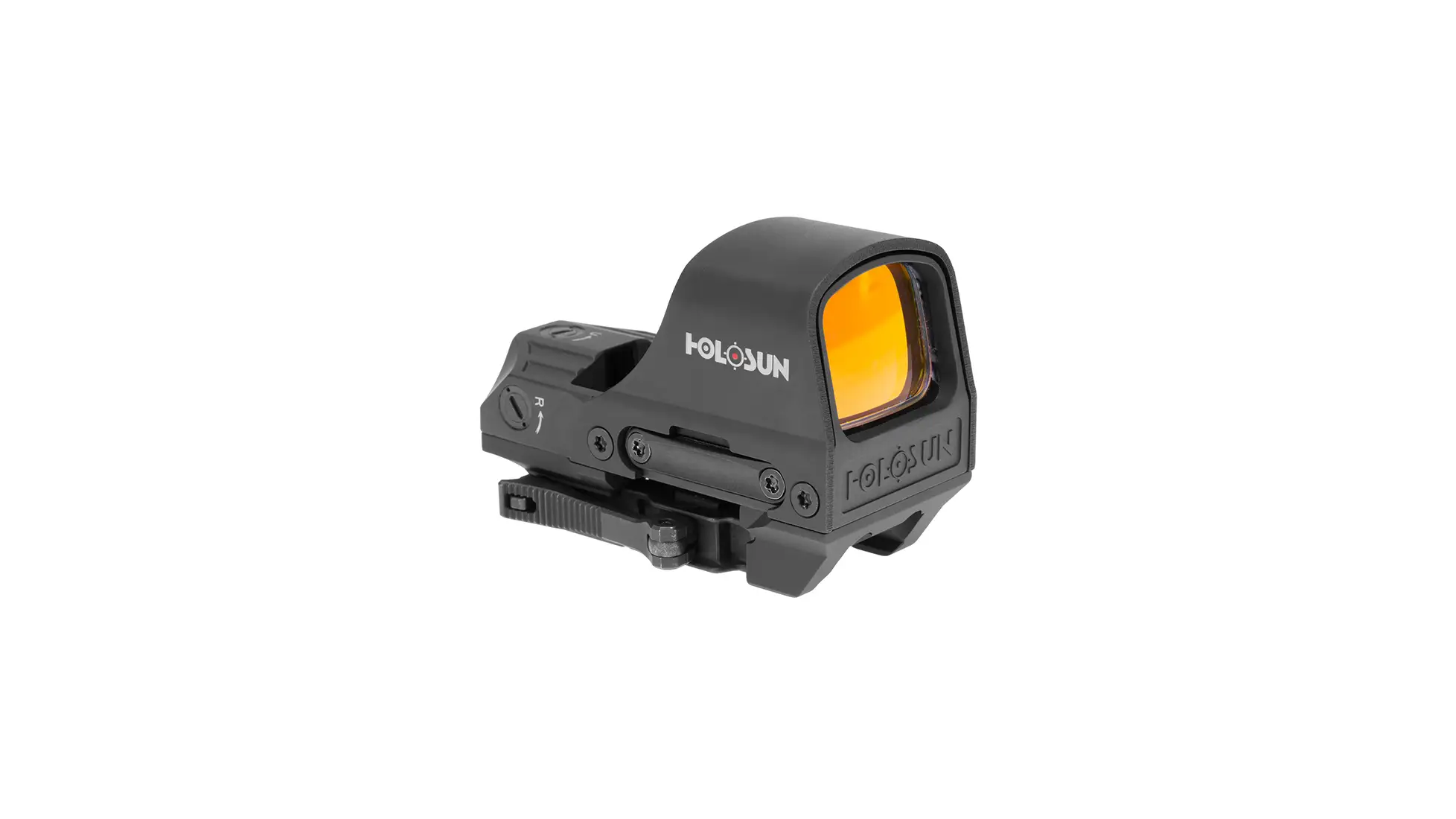
The HS510C is Holosun's large-window open reflex sight for carbines, PCCs and shotguns. A 32x24mm rectangular window sits under a Grade 5 titanium hood on a 6061-T6 aluminum body, it runs a Multi-Reticle System that toggles between a 2 MOA dot, a 65 MOA circle or both, and it ships on an integrated quick-detach mount at absolute co-witness height. The whole thing weighs 4.94 oz with the mount.
First, the thing everyone gets wrong: this is not a holographic sight
It looks like an EOTech, so people call it one. Even inside its own review pool, one owner titled his five-star review "Awesome holographic sight" while another opened his with a correction: it is important to note this is a reflex, not a holographic sight. Both descriptions cannot be right, and the second is.
The difference is how the reticle gets made. A reflex sight projects an LED forward onto a partially silvered lens. A holographic sight uses a laser to light up a recorded hologram, which is a far hungrier process. That single engineering choice is why this sight runs for tens of thousands of hours on a coin cell while holographic sights are typically rated around a thousand. If you want the full breakdown, we wrote red dot vs holographic sight.
The 65 MOA circle is doing more work than you think
The Multi-Reticle System gives you three presentations, and because all of them are projected from the same LED array, switching between them needs no re-zeroing. The 2 MOA dot is the precision option, covering about two inches at 100 yards. The 65 MOA circle is the speed option: human vision centers itself on a large geometric shape automatically, so the ring finds the middle of the window for you on presentation.
Two less obvious uses. On a shotgun, that 65 MOA ring is a close proxy for a standard buckshot pattern at 15 to 25 yards, which is why we rank it first for scatterguns and why an owner shooting an AR noticed the same thing: the circle is roughly the spread of 00 buck at 25 yards. And on any platform it doubles as a crude rangefinder, since 65 MOA is about 65 inches at 100 yards, roughly the height of an adult male, so a person who fills the circle is somewhere near 100 yards out. The stadia marks at 12, 3, 6 and 9 o clock give you a reference for the bore-to-optic offset at contact distance, where a center hold shoots low.
Power: the part that makes it a defensive optic
Two systems work together. Shake Awake sleeps the LED when the gun sits still and wakes it on the slightest movement, with independent hands-on testing putting the wake time around 0.3 seconds, faster than you can shoulder the gun. Solar Failsafe runs the reticle off the solar cell on top of the chassis if the CR2032 dies outright. So the failure mode of a rifle left in a closet for two years is: nothing happens, it just works.
Be honest about the headline number, though. The up-to-50,000-hour rating is specified for the 2 MOA dot alone at a moderate setting. Run the full 65 MOA circle and you are lighting far more LED, which cuts runtime proportionately. It is still a vast number, and the side-loading battery tray, a detail American Rifleman called out in its product preview, means you change the cell without dismounting the optic or losing zero.
Build: a titanium hood is not a marketing word here
Open-window sights are structurally vulnerable, which is the trade you accept for the field of view. Holosun's answer is a Grade 5 titanium alloy hood around the lens, on a 6061-T6 aluminum body finished with micro-arc oxidation, a ceramic-like surface treatment that is harder and more corrosion resistant than standard anodizing. It is nitrogen purged and IP67 rated, meaning a meter of water for half an hour, and it is rated to 1000G of recoil. All of that lands at 4.94 oz including the mount, when competing duty optics often pass 10 oz.
The QD mount puts the reticle at absolute co-witness with standard AR irons out of the box. If you want a heads-up, plate-carrier-friendly position, a riser or a lower 1/3 spacer is a separate purchase.
What owners say (484 reviews, 4.7/5 on OpticsPlanet)
The recurring theme across the review pool is the same comparison, made unprompted, over and over: people cross shop this against an EOTech and keep the Holosun.
“I wanted to get an EOTech for home defense, but this has a way bigger window, shake awake, and insane battery life. Does not break the bank, always works, and holds zero.”
Wingami, verified owner (FL), via OpticsPlanet
“I’ve owned both an EO Tech 512 (which I loved) and two of these. When compared, the EO Tech seems mildly tougher with very slightly better glass. The Holosun Reticle is much more crisp and seems to have less parallax. Additionally, the Holosun is an always on optic. All in all, a great home defense optic.”
Led, verified owner (SC), via OpticsPlanet
Note the second owner gives the EOTech the nod on toughness and glass. That is the honest shape of this matchup: the Holosun wins on window, reticle crispness, battery and price, not on everything.
What owners flag, plainly
The most helpful negative review is not about durability at all, it is about the menu. An owner returned the sight because it had too many bells and whistles: he kept going back to the manual to switch between manual and automatic brightness, and never got as far as changing the reticle. That is a real cost of the Multi-Reticle System, and it is worth knowing before you buy a defensive optic you will operate under stress.
The other repeated note is mechanical and has a known fix. One competition shooter with 2,500 rounds through a PCC reported the mount's tension set screw loosening during a match; a drop of blue thread locker cured it and the optic itself performed, in his words, 100 percent. OpticsPlanet's own gear expert also noticed glare from the coatings indoors out of the box, but said it never showed up on the range. That matches the known faint blue tint of long-battery-life reflex glass: occasionally visible indoors, essentially imperceptible outside.
Trade-offs, plainly
- Open emitter. Debris, heavy snow or driving rain can reach the window, so it is not the pick for austere or filthy conditions.
- The 50,000-hour figure is dot-only. The 65 MOA circle draws meaningfully more power.
- The menu has a learning curve; at least one owner returned it for exactly that reason.
- Check the mount's tension screw and consider thread locker; that is the one recurring mechanical complaint.
- A faint tint indoors, and a riser or lower 1/3 spacer costs extra if you want a heads-up position.
Key specifications
| Magnification | 1x, parallax-free, unlimited eye relief |
|---|---|
| Reticle | Multi-Reticle System: 2 MOA dot, 65 MOA circle, or both |
| Window | 32 x 24 mm open reflex |
| Emitter | Open |
| Adjustment click | 0.5 MOA |
| Brightness | 10 daylight settings + 2 night-vision |
| Battery | CR2032, side-loading tray (no dismount to change) |
| Battery life | Up to 50,000 hours (setting 6, 2 MOA dot only) |
| Power backup | Solar Failsafe + Shake Awake |
| Housing | 6061-T6 aluminum, Grade 5 titanium hood, MAO finish |
| Recoil rating | 1000G |
| Mount | Integrated quick-detach Picatinny, absolute co-witness (~1.41 in) |
| Sealing | IP67, nitrogen purged (1 m for 30 min) |
| Weight | 4.94 oz including the QD mount |
| Dimensions | 3.3 x 1.68 x 1.78 in |
Holosun also builds a green-reticle version of this sight, the HE510C-GR, which projects 540nm green instead of 650nm red. We have not verified its price or stock, so this review covers the red HS510C only and we make no recommendation on the green model.
Should you buy it, and what else to consider
- Buy it for a defensive shotgun, a home-defense carbine or a PCC where a big window, a fast circle and a battery you never think about matter most. It is our best red dot for a shotgun.
- Add a magnifier if you want reach; the 2 MOA dot magnifies well and Holosun's own HM3X (around $200) height-matches this sight at absolute co-witness. See best red dot magnifier.
- Go smaller for a pistol: the RMR-footprint HS407C-X2 (around $190) or the HS507C-X2 (around $230) fit milled slides this sight will not.
- Compare the categories in red dot vs holographic and EOTech vs Aimpoint before you spend double.
FAQ
Is the Holosun HS510C a holographic sight?
No, and this is the single most common mistake made about it. The HS510C is an open reflex sight: an LED projects the reticle forward onto a partially silvered lens. A true holographic sight uses a laser to illuminate a recorded hologram. Buyers conflate them because the big rectangular window and circle-dot reticle look like an EOTech. The practical difference is power: LED reflex sights like this run up to 50,000 hours on a coin cell, while holographic sights typically manage a few hundred to a couple of thousand hours.
Is the Holosun HS510C good for a shotgun?
Yes, it is our top pick for one. Two reasons: it is rated to withstand 1000G of recoil force, which covers 12-gauge buckshot and slugs, and its 65 MOA circle is a close proxy for a standard buckshot pattern at typical 15 to 25 yard distances, so you see the likely spread at a glance. The Grade 5 titanium hood over the window matters on a gun that gets knocked around, and solar failsafe plus shake-awake means a staged home-defense shotgun is ready without a switch.
How long does the HS510C battery really last?
Holosun rates it up to 50,000 hours, but read the fine print: that figure is for the 2 MOA dot alone at a moderate daylight setting. Running the full 65 MOA circle illuminates far more LED area and shortens runtime proportionately. In practice it is still an enormous number, and two systems back it up: Solar Failsafe runs the reticle off the top-mounted solar cell if the CR2032 dies, and the side-loading battery tray lets you swap the cell without dismounting the optic or losing zero, a detail American Rifleman highlighted in its product preview.
Can you use a magnifier with the Holosun HS510C, and does the HM3X combo work?
Yes, and the HS510C paired with Holosun's own HM3X 3x magnifier (the eye-relief pick in our magnifier roundup) is the combination people ask about most. It works because the HS510C is a 1x optic and its fine 2 MOA centre dot covers only about two inches at 100 yards, so it does not obscure a distant target the way a big circle would. Two practical notes: switch the reticle to the dot alone rather than the 65 MOA circle before you magnify, and match the heights, since the HM3X ships with a spacer for absolute or lower 1/3 co-witness and the HS510C's own quick-detach mount sits at absolute co-witness. See our best red dot magnifier guide, where the HM3X is a full pick alongside the Vortex VMX-3T and the EOTech G33.
What does the 65 MOA circle do besides look fast?
Three things. It grabs the eye instantly on presentation, because human vision centers naturally on a large geometric shape. It approximates a buckshot spread at shotgun distances. And it doubles as a rough rangefinder: 65 MOA is about 65 inches at 100 yards, roughly the height of an adult, so a person filling the circle is around 100 yards out. The stadia marks at the 12, 3, 6 and 9 o clock positions also give you a holdover reference for the bore-to-optic offset at very close range.
More: best red dot sights · best red dot for a shotgun · best shotgun scopes · Holosun HS407C-X2 review · Vortex StrikeFire II review · best red dot for an AR-15.